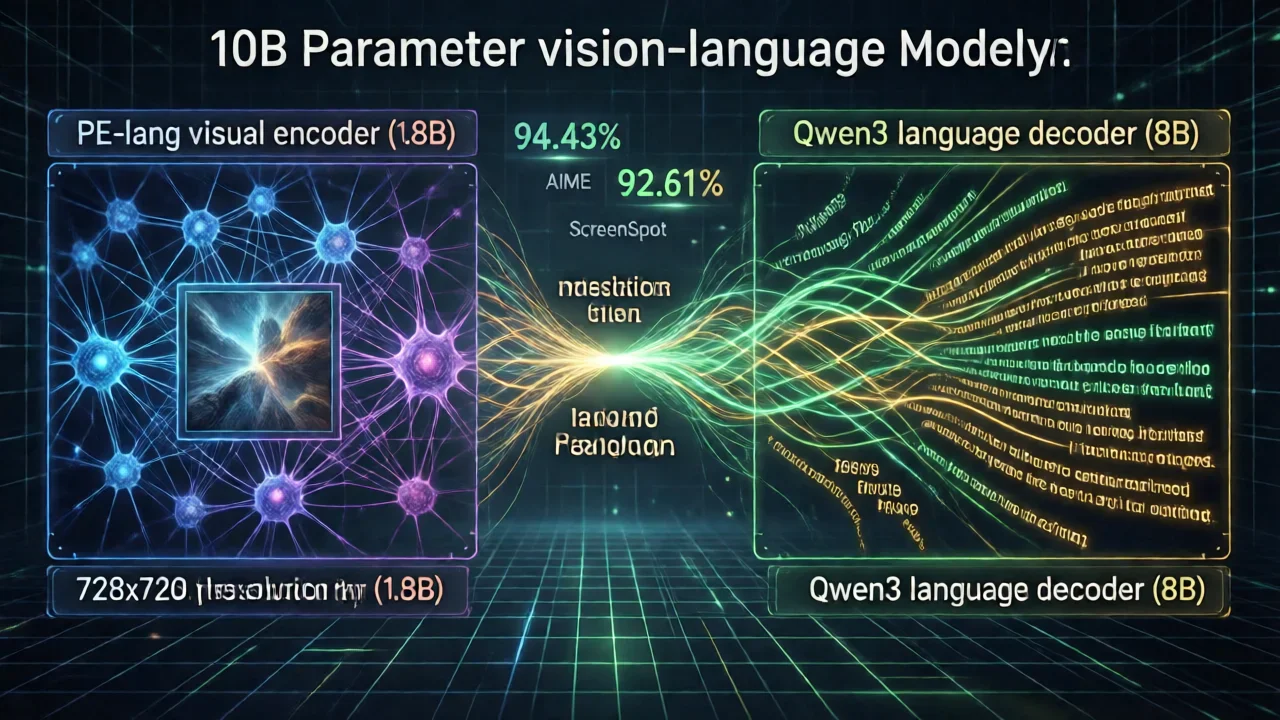
Stepfun AI just released Step3-VL-10B in January 2026. It's a 10-billion parameter vision-language model that does something unusual—it performs as well as models 10 to 20 times larger. The secret is combining a 1.8B PE-lang visual encoder with an 8B Qwen3 language decoder. If you need a vision-language model for STEM reasoning, document understanding, or GUI interaction, this one's worth a close look.
What makes Step3-VL-10B different? Instead of just throwing more parameters at the problem, Stepfun AI designed a smarter architecture. They focused on getting more performance out of each parameter through better training and architecture choices.
This design philosophy explains why Step3-VL-10B excels at tasks requiring deep semantic understanding—the visual encoder is trained to extract information in a format that language models can reason about most effectively.
Step3-VL-10B's exceptional performance stems from a carefully orchestrated training pipeline:
This multi-stage approach ensures the model develops robust reasoning capabilities while maintaining visual understanding accuracy.
The most compelling evidence of Step3-VL-10B's efficiency is its performance against significantly larger competitors.
Step3-VL-10B demonstrates exceptional performance on mathematics and physics benchmarks:
| Benchmark | Step3-VL-10B | Larger Models | Advantage |
|---|
| AIME 2025 | 94.43% (PaCoRe) | ~85-90% | +4-9% |
| HMMT 2025 | 92.14% (PaCoRe) | ~80-85% | +7-12% |
| MathVision | 75.95% (PaCoRe) | ~65-70% | +6-11% |
| OCRBench | 89.00% | ~80-85% | +4-9% |
These results are particularly impressive considering Step3-VL-10B achieves them with 10-20× fewer parameters than competing models.
General Vision-Language Understanding
Beyond STEM reasoning, Step3-VL-10B maintains competitive performance across diverse benchmarks:
| Benchmark | Step3-VL-10B | Category |
| MMMU | 78.11% | Multimodal reasoning |
| MMBench (EN) | 92.05% | General visual understanding |
| MathVista | 83.97% | Mathematical visual reasoning |
| ScreenSpot-V2 | 92.61% | GUI understanding |
The ScreenSpot-V2 score is particularly noteworthy—92.61% demonstrates Step3-VL-10B's capability for understanding and interacting with user interfaces, making it valuable for automation and accessibility applications.
The PaCoRe Advantage
Many of Step3-VL-10B's top scores utilize PaCoRe (Parallel Coordinated Reasoning), an inference-time technique that aggregates 16 parallel reasoning rollouts. This approach:
Enhances reasoning accuracy without retraining
Increases inference cost proportionally to the number of rollouts
Provides a tunable performance-efficiency tradeoff
Particularly effective for complex reasoning tasks
For applications where accuracy is paramount, PaCoRe mode offers significant performance gains. For latency-sensitive applications, standard inference mode provides excellent performance with lower computational overhead.
Technical Specifications and Hardware Requirements
Understanding Step3-VL-10B's technical requirements is essential for deployment planning.
Model Architecture Details
| Component | Specification |
| Total Parameters | 10 billion |
| Visual Encoder (PE-lang) | 1.8 billion parameters |
| Language Decoder (Qwen3) | 8 billion parameters |
| Model Weights Size | 20 GB |
| Data Type | BF16 (Brain Float 16) |
| Visual Resolution | 728×728 global + 504×504 local crops |
| Spatial Downsampling | 16× compression |
| License | Apache 2.0 |
Hardware Requirements
Minimum Configuration for Inference:
VRAM Required: 24 GB minimum
Recommended GPUs: RTX 4090, A100, H100
Model Weights: 20 GB
Runtime Overhead: ~4 GB
Total Memory: ~24 GB
Recommended Configuration for Production:
VRAM: 40-80 GB (for batching and PaCoRe mode)
GPU: A100 (80GB) or H100 (80GB)
Storage: 30 GB (model + cache)
Software Requirements:
Python 3.10 or later
PyTorch ≥ 2.1.0
Transformers 4.57.0
CUDA 11.8 or later (for GPU inference)
Inference Format
Step3-VL-10B operates exclusively in BF16 (Brain Float 16) format. This precision level:
Maintains numerical stability for deep reasoning
Reduces memory requirements compared to FP32
Provides sufficient precision for vision-language tasks
Is widely supported by modern GPUs
Quantization to INT8 or INT4 is not officially supported, though community efforts may explore this direction.
Core Capabilities and Use Cases
Step3-VL-10B excels across multiple domains, each leveraging different aspects of its architecture.
1. STEM Problem Solving
The model's exceptional STEM reasoning performance makes it ideal for:
Mathematics tutoring: Solving and explaining complex mathematical problems
Physics simulations: Understanding and analyzing physics diagrams
Chemistry visualization: Interpreting molecular structures and reactions
Engineering analysis: Understanding technical diagrams and specifications
Example use case: A student uploads a handwritten math problem. Step3-VL-10B analyzes the image, recognizes the mathematical notation, and provides step-by-step solutions.
2. Document Understanding and OCR
With 89% OCRBench performance, Step3-VL-10B handles:
Document digitization: Converting scanned documents to structured data
Form processing: Extracting information from forms and applications
Receipt analysis: Understanding and categorizing receipt content
Invoice processing: Automated invoice data extraction
The model's multi-crop resolution strategy ensures it captures both fine details (local crops) and overall document structure (global view).
3. GUI and Screen Understanding
The 92.61% ScreenSpot-V2 score demonstrates capability for:
UI automation: Understanding and interacting with application interfaces
Accessibility: Describing screen content for visually impaired users
Testing automation: Identifying UI elements for automated testing
Mobile app analysis: Understanding mobile application layouts
4. Visual Question Answering
Step3-VL-10B can answer complex questions about images:
Scene understanding: Describing what's happening in images
Object relationships: Understanding spatial relationships between objects
Contextual reasoning: Inferring information not explicitly visible
Multi-step reasoning: Answering questions requiring multiple reasoning steps
Deployment Options
Step3-VL-10B supports multiple deployment approaches, each optimized for different use cases.
Option 1: Hugging Face Transformers (Development)
For development and experimentation, use the standard Transformers library:
from transformers import AutoProcessor, AutoModelForCausalLM

model_path = "stepfun-ai/Step3-VL-10B"
processor = AutoProcessor.from_pretrained(model_path, trust_remote_code=True)
model = AutoModelForCausalLM.from_pretrained(
    model_path,
    trust_remote_code=True,
    device_map="auto",
    torch_dtype="auto"
).eval()

# Prepare input
messages = [
    {
        "role": "user",
        "content": [
            {"type": "image", "url": "image_url_or_path"},
            {"type": "text", "text": "What's in this image?"}
        ]
    }
]

# Generate response
inputs = processor.apply_chat_template(
    messages, add_generation_prompt=True, tokenize=True,
    return_dict=True, return_tensors="pt"
).to(model.device)

generate_ids = model.generate(**inputs, max_new_tokens=1024)
response = processor.decode(generate_ids[0, inputs["input_ids"].shape[-1]:], skip_special_tokens=True)
print(response)
Advantages:
Simple setup and experimentation
Direct access to model internals
Suitable for research and prototyping
Limitations:
Single-request processing
No built-in batching optimization
Limited production features
Option 2: vLLM (Production API)
For production deployments requiring OpenAI-compatible APIs:
vllm serve stepfun-ai/Step3-VL-10B \
  -tp 1 \
  --reasoning-parser deepseek_r1 \
  --enable-auto-tool-choice \
  --tool-call-parser hermes \
  --trust-remote-code
Advantages:
OpenAI-compatible API
Efficient batching and scheduling
Support for advanced reasoning modes
Production-ready performance
Ideal for:
REST API services
Batch processing
Multi-user applications
Option 3: SGLang (High-Performance Inference)
For maximum performance and advanced features:
sglang serve \
  --model-path stepfun-ai/Step3-VL-10B \
  --trust-remote-code \
  --port 2345 \
  --reasoning-parser deepseek-r1 \
  --tool-call-parser hermes
Advantages:
Optimized inference performance
Advanced scheduling algorithms
Support for complex reasoning workflows
Flexible deployment options
Ideal for:
High-throughput applications
Complex reasoning tasks
Research and experimentation
Performance Optimization Strategies
To maximize Step3-VL-10B's efficiency in production:
1. Batch Processing
Process multiple requests simultaneously to improve GPU utilization:
Batch size 4-8 for 24GB VRAM
Batch size 16-32 for 80GB VRAM
Monitor memory usage and adjust accordingly
2. PaCoRe Mode Tuning
Adjust the number of parallel rollouts based on requirements:
Standard mode: 1 rollout (baseline performance)
PaCoRe-4: 4 rollouts (moderate accuracy boost)
PaCoRe-16: 16 rollouts (maximum accuracy)
3. Input Optimization
Optimize image inputs for efficiency:
Resize images to appropriate resolution (728×728 or smaller)
Use JPEG compression for storage efficiency
Batch similar-sized images together
4. Caching Strategies
Implement caching for repeated queries:
Cache model outputs for identical inputs
Use KV-cache optimization for sequential reasoning
Implement LRU cache for memory efficiency
Comparison with Alternative Vision-Language Models
To understand Step3-VL-10B's position in the landscape:
vs. GPT-4V (Closed-source)
Step3-VL-10B Advantages:
Open-source and freely available
Can be self-hosted
Lower inference costs
Comparable STEM reasoning performance
GPT-4V Advantages:
Broader general knowledge
More polished user experience
Continuous updates and improvements
vs. Claude Vision (Closed-source)
Step3-VL-10B Advantages:
Open-source deployment
Specialized STEM reasoning
Lower latency for self-hosted deployment
Claude Vision Advantages:
Broader reasoning capabilities
Better at nuanced understanding
Integrated with Claude ecosystem
vs. Open-source Alternatives (LLaVA, Qwen-VL)
Step3-VL-10B Advantages:
Superior STEM reasoning performance
Better OCR and document understanding
More efficient parameter usage
Stronger GUI understanding
LLaVA/Qwen-VL Advantages:
Smaller model variants available
Broader community support
More deployment examples
Getting Started with Step3-VL-10B
Step 1: Environment Setup
# Create virtual environment
python -m venv step3_env
source step3_env/bin/activate

# Install dependencies
pip install torch torchvision torchaudio --index-url https://download.pytorch.org/whl/cu118
pip install transformers>=4.57.0
pip install pillow requests
Step 2: Download Model
# Using Hugging Face CLI
huggingface-cli download stepfun-ai/Step3-VL-10B --local-dir ./step3-vl-10b
Step 3: Run Inference
from transformers import AutoProcessor, AutoModelForCausalLM
from PIL import Image
import requests

# Load model
model_path = "./step3-vl-10b"
processor = AutoProcessor.from_pretrained(model_path, trust_remote_code=True)
model = AutoModelForCausalLM.from_pretrained(
    model_path,
    trust_remote_code=True,
    device_map="auto",
    torch_dtype="auto"
).eval()

# Load image
image = Image.open("path/to/image.jpg")

# Prepare input
messages = [
    {
        "role": "user",
        "content": [
            {"type": "image", "image": image},
            {"type": "text", "text": "Analyze this image in detail."}
        ]
    }
]

# Generate response
inputs = processor.apply_chat_template(
    messages, add_generation_prompt=True, tokenize=True,
    return_dict=True, return_tensors="pt"
).to(model.device)

with torch.no_grad():
    generate_ids = model.generate(**inputs, max_new_tokens=2048)

response = processor.decode(generate_ids[0, inputs["input_ids"].shape[-1]:], skip_special_tokens=True)
print(response)
Limitations and Considerations
While Step3-VL-10B is impressive, understanding its limitations is important:
1. Inference Latency
Requires 24GB VRAM minimum
Inference time: 5-15 seconds per image (depending on complexity)
PaCoRe mode increases latency proportionally
2. Knowledge Cutoff
Training data cutoff: Early 2026
May lack information about very recent events
Requires fine-tuning for domain-specific knowledge
3. Language Support
Primarily optimized for English and Chinese
Other languages supported but with lower performance
Multilingual reasoning may be less robust
4. Specialized Tasks
Not optimized for real-time video processing
Limited support for audio-visual reasoning
May struggle with highly specialized domains without fine-tuning
Future Developments and Roadmap
The vision-language model landscape continues to evolve rapidly. Potential future developments for Step3-VL-10B include:
Quantized variants: INT8 and INT4 versions for edge deployment
Smaller models: 3B and 5B parameter variants for resource-constrained environments
Multimodal extensions: Integration with audio and video understanding
Fine-tuned variants: Domain-specific versions for specialized applications
Improved efficiency: Further optimization of the PE-lang architecture
Conclusion
Step3-VL-10B represents a significant achievement in efficient vision-language model design. By combining innovative architecture (PE-lang encoder), sophisticated training strategies (multi-stage pipeline with RL), and careful parameter allocation (1.8B + 8B split), Stepfun AI has created a model that delivers exceptional performance while remaining practical for self-hosted deployment.
Whether you're building STEM tutoring systems, document processing pipelines, or GUI automation tools, Step3-VL-10B offers a compelling combination of capability, efficiency, and accessibility. The model's open-source Apache 2.0 license ensures you can deploy it freely in both research and commercial applications.
The era of efficient, capable vision-language models is here. Step3-VL-10B is leading the charge.
Resources:
Step3-VL-10B on Hugging Face
GitHub Repository
arXiv Paper
Official Documentation
Link
Z-Image: Free AI Image Generator
Z-Image-Turbo: Free AI Image Generator
Free Sora Watermark Remover
Zimage.run Google Site
Zhi Hu
Twitter
LTX-2