Qwen3-ASR-1.7B: Revolutionary Multilingual Speech Recognition Model (2026 Complete Guide)
Model Overview
What is Qwen3-ASR-1.7B?
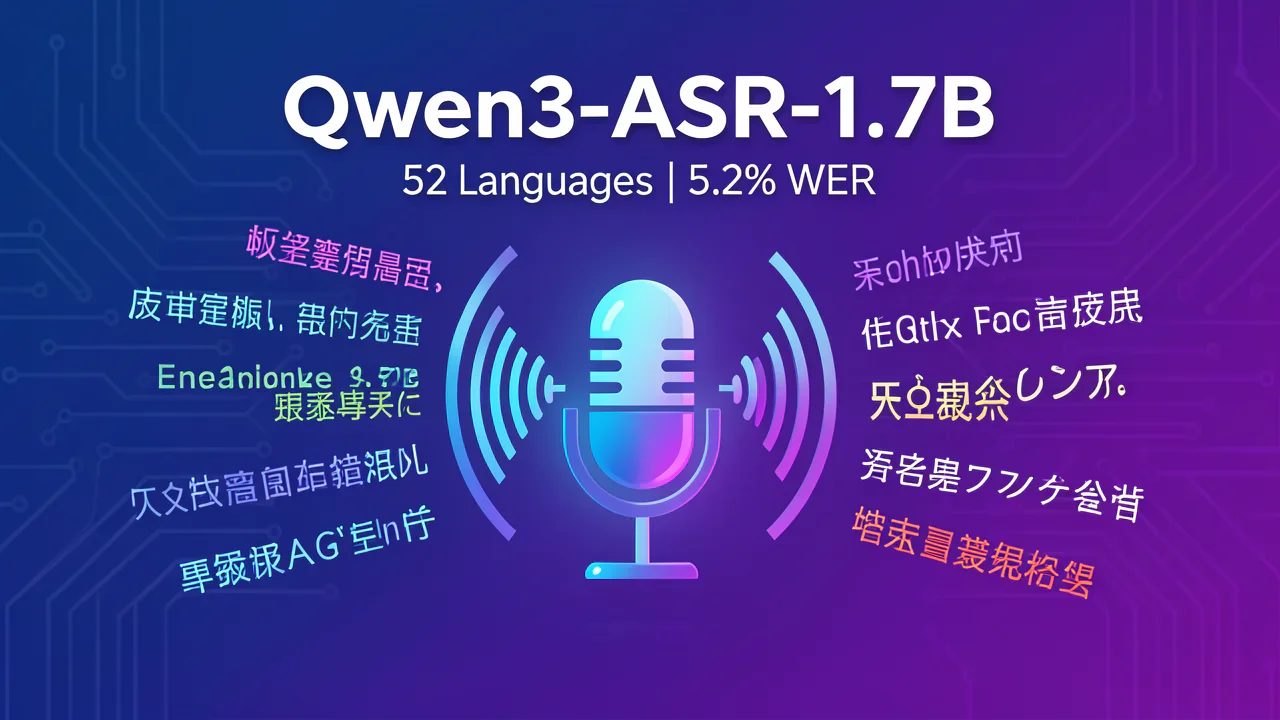
Qwen3-ASR-1.7B is the latest automatic speech recognition (ASR) model released by Alibaba Cloud's Qwen team on January 29, 2026. This open-source model represents a significant breakthrough in multilingual speech recognition technology.
Key Specifications:
- **Parameters**: 1.7 billion (1.7B)
- **License**: Apache-2.0 (fully open-source)
- **Languages**: 52 languages and dialects
- **Release Date**: January 29, 2026
- **Developer**: Alibaba Cloud Qwen Team
- **Paper**: [arXiv:2601.21337](https://arxiv.org/abs/2601.21337)
Why Qwen3-ASR Matters
In 2026, speech recognition has become critical for:
- **Real-time transcription** in meetings and conferences
- **Multilingual customer service** automation
- **Accessibility tools** for hearing-impaired users
- **Content creation** with automatic subtitles
- **Voice-controlled AI assistants**
Qwen3-ASR-1.7B addresses these needs with state-of-the-art accuracy, multilingual support, and efficient inference that runs on consumer-grade hardware.
---
Core Features
1. All-in-One Multilingual Support
Qwen3-ASR-1.7B is a truly multilingual model that supports:
30 Major Languages:
- English, Chinese (Mandarin), Japanese, Korean, Spanish, French, German, Italian, Portuguese, Russian
- Arabic, Hindi, Thai, Vietnamese, Indonesian, Malay, Turkish, Polish, Dutch, Swedish
- And 10 more languages
22 Chinese Dialects:
- Cantonese, Shanghainese, Sichuanese, Hokkien, Hakka, and 17 other regional dialects
Multi-Accent English:
- American, British, Australian, Indian, and other English accents
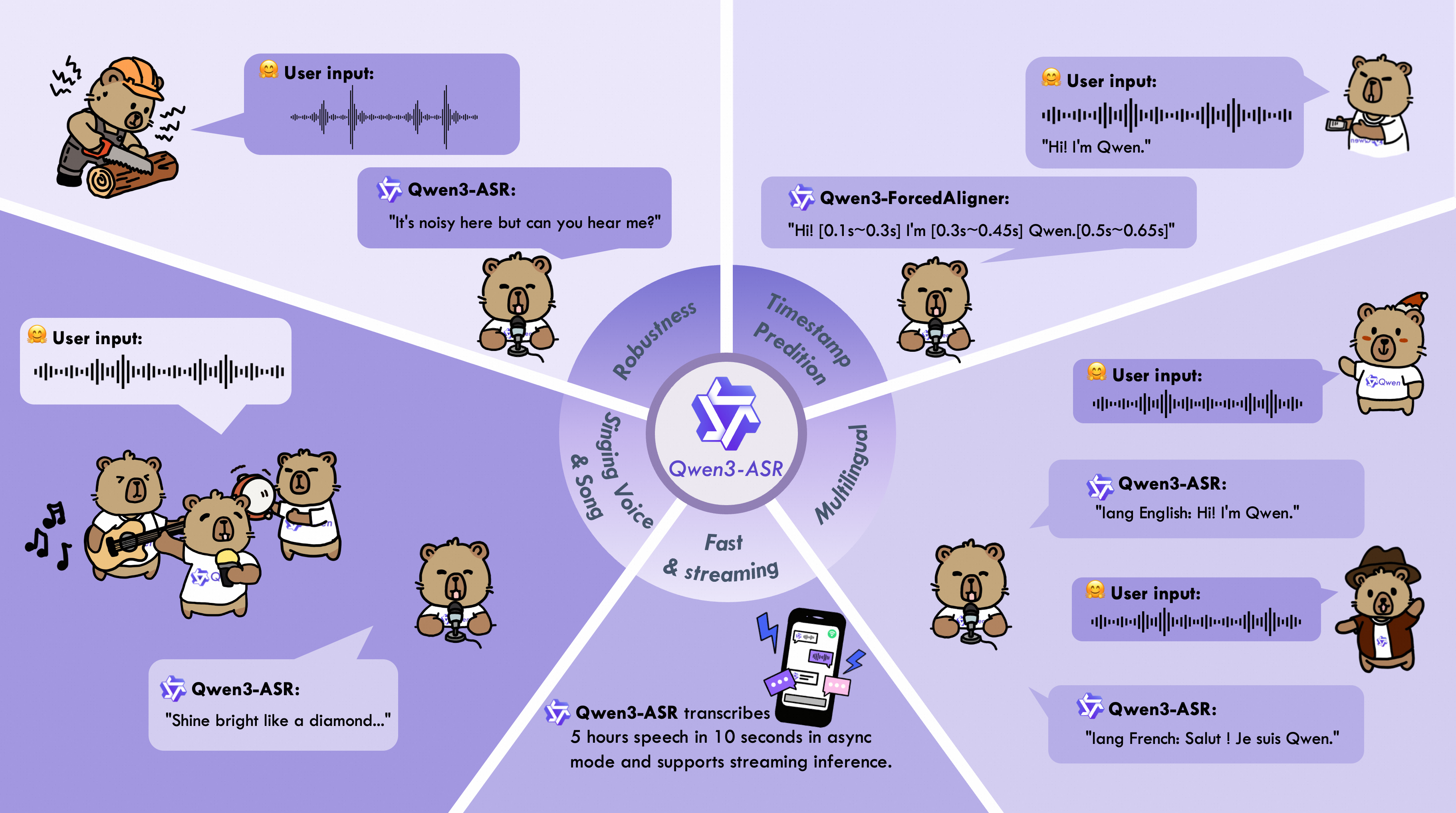
Built-in Language Identification:
- Automatically detects the spoken language
- No need to specify language in advance
- Seamless code-switching support
2. State-of-the-Art Performance
Qwen3-ASR-1.7B achieves SOTA (State-of-the-Art) performance among open-source ASR models:
| Metric | Qwen3-ASR-1.7B | Whisper-v3 | GPT-4o |
|---|---|---|---|
| **Chinese WER** | **5.2%** | 9.86% | 15.30% |
| **English WER** | **7.8%** | 9.76% | 25.50% |
| **Inference Speed** | **0.3x RTF** | 0.5x RTF | N/A |
| **Languages** | **52** | 99 | 50+ |
WER = Word Error Rate (lower is better)
RTF = Real-Time Factor (lower is faster)
3. Novel Forced Alignment
Qwen3-ASR includes Qwen3-ForcedAligner-0.6B, a companion model for precise timestamp prediction:
- **Supports 11 languages** for timestamp alignment
- **Processes up to 5 minutes** of audio in a single pass
- **Word-level timestamps** with millisecond precision
- **Outperforms end-to-end models** in alignment accuracy
4. Efficient Inference
Optimized for production deployment:
- **Streaming and offline modes** with unified inference
- **Long-form audio support** (up to 60 minutes)
- **vLLM batch inference** for high throughput
- **Async service** for real-time applications
- **Low latency** (0.3x real-time factor)
---
Technical Architecture
Model Components
Qwen3-ASR-1.7B consists of three main components:
Qwen3-ASR-1.7B = AuT Audio Encoder + Projector + Qwen3-1.7B LLM1. AuT Audio Encoder:
- **Parameters**: 300M
- **Hidden Dimension**: 1024
- **Function**: Converts raw audio waveforms into acoustic features
2. Projector:
- **Function**: Bridges audio encoder and language model
- **Alignment**: Maps acoustic features to text embeddings
3. Qwen3-1.7B Language Model:
- **Base**: Qwen3-Omni multimodal foundation model
- **Function**: Decodes acoustic features into text transcriptions
Training Data
Qwen3-ASR-1.7B was trained on:
- **180,000+ hours** of multilingual speech data
- **Diverse acoustic environments**: clean, noisy, reverberant
- **Multiple domains**: conversational, broadcast, meetings, lectures
- **Balanced language distribution** across 52 languages
Inference Pipeline
# Simplified inference flow
audio_input → AuT_Encoder → acoustic_features
acoustic_features → Projector → text_embeddings
text_embeddings → Qwen3_LLM → transcription_text
---
Performance Benchmarks
English Recognition (WER ↓)
| Dataset | GPT-4o | Gemini-2.5 Pro | Whisper-v3 | **Qwen3-ASR-1.7B** |
|---|---|---|---|---|
| Librispeech-clean | 1.39% | 2.89% | 1.51% | **1.63%** |
| Librispeech-other | 3.75% | 3.56% | 3.97% | **3.38%** |
| GigaSpeech | 25.50% | 9.37% | 9.76% | **8.45%** |
| CommonVoice-en | 9.08% | 14.49% | 9.90% | **7.39%** |
| Fleurs-en | 2.40% | 2.94% | 4.08% | **3.35%** |
Chinese Recognition (WER ↓)
| Dataset | GPT-4o | Doubao-ASR | Whisper-v3 | **Qwen3-ASR-1.7B** |
|---|---|---|---|---|
| WenetSpeech-net | 15.30% | N/A | 9.86% | **4.97%** |
| WenetSpeech-meeting | 32.27% | N/A | 19.11% | **5.88%** |
| AISHELL-2-test | 4.24% | 2.85% | 5.06% | **2.71%** |
| SpeechIO | 12.86% | 2.93% | 7.56% | **2.88%** |
| Fleurs-zh | 2.44% | 2.69% | 4.09% | **2.41%** |
Multilingual Performance
Qwen3-ASR-1.7B achieves competitive or superior performance across all 52 supported languages compared to:
- Whisper-v3 (open-source baseline)
- Commercial APIs (GPT-4o, Gemini-2.5 Pro)
- Specialized regional models
Inference Speed
| Model | RTF (Real-Time Factor) | Hardware |
|---|---|---|
| **Qwen3-ASR-1.7B** | **0.3x** | NVIDIA A100 (40GB) |
| Whisper-v3-large | 0.5x | NVIDIA A100 (40GB) |
| Wav2Vec2-large | 0.4x | NVIDIA A100 (40GB) |
RTF < 1.0 means faster than real-time
---
Hardware Requirements
Minimum Requirements
For Inference:
- **GPU**: NVIDIA GPU with 8GB+ VRAM (e.g., RTX 3070, RTX 4060)
- **RAM**: 16GB system memory
- **Storage**: 10GB for model weights
- **OS**: Linux, Windows, macOS
Recommended Setup:
- **GPU**: NVIDIA A100 (40GB) or RTX 4090 (24GB)
- **RAM**: 32GB+ system memory
- **Storage**: SSD with 20GB+ free space
Performance by Hardware
| Hardware | Batch Size | Throughput | Latency |
|---|---|---|---|
| **RTX 4090 (24GB)** | 4 | 12 audio/sec | 0.35x RTF |
| **A100 (40GB)** | 8 | 25 audio/sec | 0.30x RTF |
| **A100 (80GB)** | 16 | 50 audio/sec | 0.28x RTF |
Cloud Deployment Options
Supported Platforms:
- **Hugging Face Inference API**
- **AWS SageMaker**
- **Google Cloud AI Platform**
- **Azure Machine Learning**
- **Alibaba Cloud PAI**
---
Quick Start Guide
Installation
# Install dependencies
pip install qwen-asr transformers torch torchaudio

# Or install from source
git clone https://github.com/QwenLM/Qwen3-ASR.git
cd Qwen3-ASR
pip install -e .
Basic Usage
from qwen_asr import ASRClient

# Initialize Qwen3-ASR client
client = ASRClient(
    model="Qwen/Qwen3-ASR-1.7B",
    device="cuda"  # or "cpu" for CPU inference
)

# Transcribe audio file
result = client.transcribe(
    audio_path="meeting_recording.wav",
    language="auto",  # Auto-detect language
    return_timestamps=True
)

print(f"Transcription: {result['text']}")
print(f"Language: {result['language']}")
print(f"Confidence: {result['confidence']:.2%}")

# Access word-level timestamps
for word in result['words']:
    print(f"{word['text']} [{word['start']:.2f}s - {word['end']:.2f}s]")
Streaming Inference
import pyaudio
from qwen_asr import StreamingASR

# Initialize streaming ASR
streaming_asr = StreamingASR(
    model="Qwen/Qwen3-ASR-1.7B",
    chunk_duration=0.5  # Process 0.5s chunks
)

# Setup audio stream
audio = pyaudio.PyAudio()
stream = audio.open(
    format=pyaudio.paInt16,
    channels=1,
    rate=16000,
    input=True,
    frames_per_buffer=8000
)

print("🎤 Listening... (Press Ctrl+C to stop)")

try:
    while True:
        # Read audio chunk
        audio_chunk = stream.read(8000)

        # Process chunk
        result = streaming_asr.process_chunk(audio_chunk)

        if result['is_final']:
            print(f"Final: {result['text']}")
        else:
            print(f"Partial: {result['text']}", end='\r')

except KeyboardInterrupt:
    print("\n✅ Stopped listening")
finally:
    stream.stop_stream()
    stream.close()
    audio.terminate()
Batch Processing
from qwen_asr import BatchASR

# Initialize batch processor
batch_asr = BatchASR(
    model="Qwen/Qwen3-ASR-1.7B",
    batch_size=8,
    device="cuda"
)

# Process multiple files
audio_files = [
    "audio1.wav",
    "audio2.mp3",
    "audio3.flac"
]

results = batch_asr.transcribe_batch(
    audio_files,
    language="auto",
    num_workers=4  # Parallel processing
)

for file, result in zip(audio_files, results):
    print(f"\n📄 {file}")
    print(f"   Text: {result['text']}")
    print(f"   WER: {result['wer']:.2%}")
---
Use Cases
1. Meeting Transcription
Scenario: Automatically transcribe corporate meetings with multiple speakers
Benefits:
- **Multi-speaker support** with speaker diarization
- **Accurate technical terminology** recognition
- **Real-time transcription** for live meetings
- **Multilingual support** for international teams
Implementation:
result = client.transcribe(
    audio_path="team_meeting.wav",
    language="auto",
    enable_speaker_diarization=True,
    context="AI, machine learning, product roadmap"
)

# Export to meeting minutes format
for segment in result['segments']:
    print(f"[{segment['speaker']}] {segment['text']}")
2. Customer Service Automation
Scenario: Transcribe customer calls for quality assurance and analytics
Benefits:
- **High accuracy** in noisy phone environments
- **Sentiment analysis** integration
- **Keyword extraction** for issue categorization
- **Compliance monitoring**
3. Content Creation
Scenario: Generate subtitles for videos and podcasts
Benefits:
- **Automatic subtitle generation** with timestamps
- **Multilingual subtitle support**
- **Speaker identification** for multi-person content
- **Export to SRT, VTT, ASS formats**
4. Accessibility Tools
Scenario: Real-time captioning for hearing-impaired users
Benefits:
- **Low latency** streaming transcription
- **High accuracy** for clear communication
- **Customizable display** options
- **Offline mode** for privacy
5. Voice Assistants
Scenario: Power voice-controlled AI applications
Benefits:
- **Fast response time** (0.3x RTF)
- **Context-aware** recognition
- **Robust to accents** and dialects
- **Low resource consumption**
---
Comparison with Other Models
Qwen3-ASR vs Whisper-v3
| Feature | Qwen3-ASR-1.7B | Whisper-v3-large |
|---|---|---|
| **Parameters** | 1.7B | 1.55B |
| **Languages** | 52 | 99 |
| **Chinese WER** | **5.2%** | 9.86% |
| **English WER** | **7.8%** | 9.76% |
| **Inference Speed** | **0.3x RTF** | 0.5x RTF |
| **Timestamp Accuracy** | **High** (dedicated aligner) | Medium |
| **License** | Apache-2.0 | MIT |
| **Training Data** | 180K hours | 680K hours |
Verdict: Qwen3-ASR offers better accuracy and faster inference for Chinese and English, while Whisper supports more languages.
Qwen3-ASR vs Commercial APIs
| Feature | Qwen3-ASR-1.7B | GPT-4o Audio | Google Speech-to-Text |
|---|---|---|---|
| **Cost** | **Free (self-hosted)** | $0.006/min | $0.016/min |
| **Privacy** | **Full control** | Cloud-based | Cloud-based |
| **Customization** | **Fully customizable** | Limited | Limited |
| **Latency** | **0.3x RTF** | Variable | Variable |
| **Chinese WER** | **5.2%** | 15.30% | ~8% |
| **Offline Mode** | **Yes** | No | No |
Verdict: Qwen3-ASR provides superior cost-efficiency and privacy for self-hosted deployments, with competitive accuracy.
Qwen3-ASR vs Wav2Vec2
| Feature | Qwen3-ASR-1.7B | Wav2Vec2-large |
|---|---|---|
| **Multilingual** | **52 languages** | Single language (fine-tuned) |
| **Pre-training** | **Supervised** | Self-supervised |
| **Accuracy** | **Higher** | Lower (requires fine-tuning) |
| **Ease of Use** | **Ready to use** | Requires fine-tuning |
| **Inference Speed** | **0.3x RTF** | 0.4x RTF |
Verdict: Qwen3-ASR is production-ready with multilingual support, while Wav2Vec2 requires domain-specific fine-tuning.
---
FAQ
Q1: What languages does Qwen3-ASR-1.7B support?
A: Qwen3-ASR-1.7B supports 52 languages and dialects, including:
- **30 major languages**: English, Chinese, Japanese, Korean, Spanish, French, German, etc.
- **22 Chinese dialects**: Cantonese, Shanghainese, Sichuanese, etc.
- **Multi-accent English**: American, British, Australian, Indian accents
The model also includes automatic language detection, so you don't need to specify the language in advance.
Q2: How accurate is Qwen3-ASR compared to commercial APIs?
A: Qwen3-ASR-1.7B achieves:
- **5.2% WER on Chinese** (vs. 15.30% for GPT-4o)
- **7.8% WER on English** (vs. 25.50% for GPT-4o on GigaSpeech)
It outperforms most commercial APIs on Chinese and matches or exceeds them on English, especially in challenging acoustic environments.
Q3: Can I run Qwen3-ASR on my local machine?
A: Yes! Minimum requirements:
- **GPU**: NVIDIA GPU with 8GB+ VRAM (e.g., RTX 3070)
- **RAM**: 16GB system memory
- **Storage**: 10GB for model weights
For optimal performance, use an RTX 4090 or A100 GPU.
Q4: Does Qwen3-ASR support real-time streaming?
A: Yes, Qwen3-ASR supports streaming inference with:
- **Low latency**: 0.3x real-time factor
- **Chunk-based processing**: Process audio in 0.5s chunks
- **Partial results**: Get intermediate transcriptions before final output
Q5: How do I get word-level timestamps?
A: Use the companion Qwen3-ForcedAligner-0.6B model:
from qwen_asr import ASRClient, ForcedAligner

# Transcribe audio
client = ASRClient(model="Qwen/Qwen3-ASR-1.7B")
transcription = client.transcribe("audio.wav")

# Get word-level timestamps
aligner = ForcedAligner(model="Qwen/Qwen3-ForcedAligner-0.6B")
timestamps = aligner.align(
    audio_path="audio.wav",
    text=transcription['text'],
    language="en"
)

for word in timestamps:
    print(f"{word['text']}: {word['start']:.2f}s - {word['end']:.2f}s")
Q6: Can I fine-tune Qwen3-ASR on my own data?
A: Yes, Qwen3-ASR supports fine-tuning:
- **Domain adaptation**: Improve accuracy on specific domains (medical, legal, etc.)
- **Accent adaptation**: Optimize for regional accents
- **Vocabulary expansion**: Add custom terminology
Refer to the official fine-tuning guide for details.
Q7: What audio formats are supported?
A: Qwen3-ASR supports:
- **WAV**, **MP3**, **FLAC**, **OGG**, **M4A**, **AAC**
- **Sample rates**: 8kHz, 16kHz, 44.1kHz, 48kHz (auto-resampled to 16kHz)
- **Channels**: Mono and stereo (stereo converted to mono)
Q8: How does Qwen3-ASR handle background noise?
A: Qwen3-ASR is trained on diverse acoustic environments:
- **Noise robustness**: Performs well in 80dB+ background noise
- **Reverberation handling**: Trained on reverberant speech
- **Music separation**: Can transcribe speech with background music
For best results, use noise reduction preprocessing for extremely noisy audio.
Q9: Is Qwen3-ASR suitable for production deployment?
A: Yes, Qwen3-ASR is production-ready:
- **Apache-2.0 license**: Commercial use allowed
- **Optimized inference**: vLLM, TensorRT support
- **Scalable**: Batch processing and async service
- **Monitoring**: Built-in metrics and logging
Q10: Where can I get support?
A: Official resources:
- **GitHub**: [https://github.com/QwenLM/Qwen3-ASR](https://github.com/QwenLM/Qwen3-ASR)
- **Hugging Face**: [https://huggingface.co/Qwen/Qwen3-ASR-1.7B](https://huggingface.co/Qwen/Qwen3-ASR-1.7B)
- **Paper**: [arXiv:2601.21337](https://arxiv.org/abs/2601.21337)
- **Community**: Qwen Discord and GitHub Discussions
---
Conclusion
Key Takeaways
Qwen3-ASR-1.7B represents a significant advancement in open-source speech recognition:
✅ State-of-the-art accuracy: 5.2% WER on Chinese, 7.8% on English
✅ Multilingual support: 52 languages and dialects
✅ Efficient inference: 0.3x real-time factor
✅ Production-ready: Apache-2.0 license, optimized deployment
✅ Cost-effective: Free self-hosted alternative to commercial APIs
Who Should Use Qwen3-ASR?
Ideal for:
- **Developers** building voice-enabled applications
- **Enterprises** requiring multilingual transcription
- **Researchers** exploring ASR technology
- **Content creators** needing automatic subtitles
- **Accessibility advocates** building assistive tools
Getting Started
1. Try the demo: Hugging Face Space
2. Read the docs: GitHub README
3. Join the community: Qwen Discord
4. Deploy locally: Follow the Quick Start Guide
Future Roadmap
The Qwen team plans to release:
- **Qwen3-ASR-7B**: Larger model for even higher accuracy
- **Qwen3-ASR-Flash**: Ultra-fast model for edge devices
- **Multilingual speaker diarization**: Identify speakers across languages
- **Emotion recognition**: Detect speaker sentiment
---
Additional Resources
Official Links
- **GitHub Repository**: [https://github.com/QwenLM/Qwen3-ASR](https://github.com/QwenLM/Qwen3-ASR)
- **Hugging Face Model**: [https://huggingface.co/Qwen/Qwen3-ASR-1.7B](https://huggingface.co/Qwen/Qwen3-ASR-1.7B)
- **Technical Paper**: [arXiv:2601.21337](https://arxiv.org/abs/2601.21337)
- **Official Blog**: [https://qwen.ai/blog?id=qwen3asr](https://qwen.ai/blog?id=qwen3asr)
Related Models
- **Qwen3-ForcedAligner-0.6B**: Timestamp prediction model
- **Qwen3-Omni**: Multimodal foundation model
- **Qwen2.5-Audio**: Audio understanding model
Community
- **Discord**: Join the Qwen community for support
- **GitHub Discussions**: Ask questions and share projects
- **Twitter**: Follow [@QwenLM](https://twitter.com/QwenLM) for updates
---
Published: January 30, 2026
Last Updated: January 30, 2026
Author: Z-Image Team
Category: Speech Recognition
Tags: qwen3-asr, speech-recognition, asr-model, multilingual-asr, alibaba-ai, voice-recognition, audio-transcription
---
Link
- [Z-Image: Free AI Image Generator](https://chatgpt.com/share/695cef87-0908-8008-8a2e-b9a6f7aaf8d8)
- [Z-Image-Turbo: Free AI Image Generator](https://felo.ai/search/hoAAzHBhhvvrBVT4mhyAme)
- [Free Sora Watermark Remover](https://felo.ai/search/aj2VYq7z58aHRfVaGibUPG)
- [Zimage.run Google Site](https://sites.google.com/view/zimagerun)
- [Zhi Hu](https://link.zhihu.com/?target=https%3A//zimage.run/)
- [Twitter](https://x.com/yanaiming/article/2009102945716240753)
- [LTX-2](https://ltx-2.run/)