1. Introduction: What is Kimi K2.5?
Kimi K2.5 is Moonshot AI's latest large language model, released and open-sourced in January 2026. It's a multimodal model that can handle text, images, and videos simultaneously. The biggest advantage is that it's completely open-source and compatible with OpenAI's API, meaning you can use it for commercial projects or deploy it yourself.
The model is massive: 1.04 trillion parameters, but only activates 32 billion per inference. This design (called MoE - Mixture of Experts) makes it both powerful and efficient.
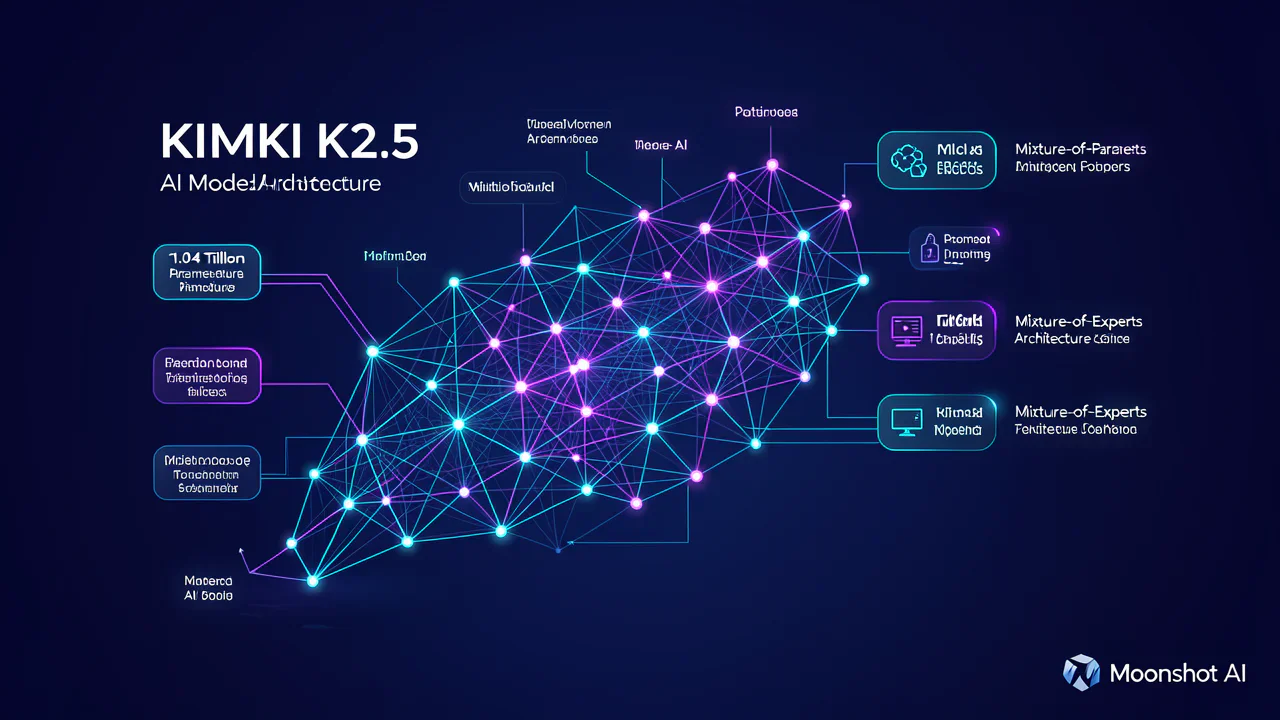
Key Advantages:
1.04 trillion parameters, 32B active per inference
256K context window - can handle very long documents
Native multimodal - understands text, images, and videos
Agent Swarm mode - execute 1,500 tool calls in parallel
Performance matches GPT-5.2 and Claude 4.5, sometimes better
2. Model Architecture and Parameters
Kimi K2.5 uses a Mixture-of-Experts (MoE) architecture. Instead of using all parameters for every computation, it dynamically selects the experts it needs. This keeps the model both capable and efficient.
Technical Specs:
Total parameters: 1.04 trillion
Active parameters: 32 billion per inference
Layers: 61
Experts: 384 total, 8 selected per token
Context length: 256K tokens
Vocabulary: 160K tokens
Vision encoder: MoonViT (400M parameters)
Training Data:
Pre-trained on approximately 15 trillion mixed visual and text tokens. This means the model saw both massive amounts of text and images/videos during training, so it understands all these different types of information.
Quantized Versions:
If your hardware isn't powerful enough, you can use quantized versions. The 1.8-bit quantization compresses the model from 630GB to 240GB, making it runnable on consumer-grade GPUs.
3. Performance Benchmarks: How Does Kimi K2.5 Compare?
Let's look at how Kimi K2.5 performs against GPT-5.2 and Claude 4.5 Opus - currently the strongest models out there.
Reasoning and Knowledge Tests:
| Test | Kimi K2.5 | GPT-5.2 | Claude 4.5 Opus |
|---|
| AIME 2025 | 96.1 | 100 | 92.8 |
| GPQA-Diamond | 87.6 | 92.4 | 87.0 |
| MMLU-Pro | 87.1 | 86.7 | 89.3 |
| HLE-Full (with tools) | 50.2 | 41.7 | 32.0 |
Kimi K2.5 is very close to the strongest models on most tests. Notably, on HLE-Full it actually outperforms GPT-5.2.
Code Generation:
SWE-Bench Verified: 76.8%
SWE-Bench Multilingual: 73.0%
Particularly good at generating complete, beautiful interactive UIs from natural language
Multimodal Understanding:
MMMU-Pro: 78.5%
VideoMMU: 86.6%
OCRBench: 92.3%
OmniDocBench 1.5: 88.8%
Agent Capabilities:
BrowseComp (Agent Swarm): 78.4% (4.9 percentage point improvement over single-agent mode)
DeepSearchQA: 77.1%
4. Core Features and Capabilities
Native Multimodality
Kimi K2.5 was designed for multimodality from the start, not as an afterthought. It uses the MoonViT vision encoder to handle text, images, and videos seamlessly. This native design is much better than models that just "bolt on" vision capabilities.
Multiple Operating Modes
The model supports four modes:
Instant mode: Fast responses for real-time applications
Thinking mode: Deep reasoning for complex problems
Agent mode: Single agent executes tasks and calls tools
Agent Swarm mode: Up to 100 sub-agents work in parallel
Agent Swarm is particularly powerful. It can execute 1,500 tool calls simultaneously and is 4.5x faster than single-agent setups. Great for handling complex multi-step tasks.
Code Generation
Kimi K2.5 excels at code generation:
Generate complete interactive UIs directly from natural language
Create code from design mockups
Automatically chain multiple tools for visual data processing
Support full-stack development from requirements to deployment
Visual Understanding
With native multimodal architecture, it's strong at:
Image analysis and understanding
Video content comprehension
UI design to code conversion
Document OCR and understanding
5. Hardware Requirements and Deployment
Want to run Kimi K2.5 locally? Hardware needs depend on which version you choose.
Full Model (630GB):
Minimum: 4x H200 GPUs
Recommended: 8x H200 GPUs for optimal performance
Quantized Model (240GB, 1.8-bit):
Minimum: Single 24GB GPU with MoE layers offloaded to RAM/SSD
Recommended: 256GB+ unified memory (RAM + VRAM) for 10+ tokens/s
Actual performance: ~5 tokens/s with 256GB RAM
Inference Speed:
Fireworks AI achieves 200 tokens/s on Kimi K2.5 - 75% faster than other GPU inference services.
Recommended Inference Engines:
vLLM
SGLang
KTransformers
Don't Want to Deploy Locally?
Use the API instead:
Official API: https://platform.moonshot.ai
Kimi.com web interface
Kimi App mobile app
Kimi Code CLI (for developers)
6. Use Cases and Applications
Software Development
Rapid UI/UX development from design specs
Full-stack application development
Code review and optimization
Bug detection and fixing
Enterprise Automation
Document processing and analysis
Complex workflow automation with Agent Swarm
Multi-step task orchestration
Business intelligence and data analysis
Visual Analysis
Image and video understanding
Document OCR and information extraction
Design to code conversion
Visual debugging
Research and Development
Complex reasoning tasks
Mathematical problem-solving
Scientific research assistance
Knowledge synthesis
7. Conclusion
Kimi K2.5 is a major milestone in open-source AI. With 1.04 trillion parameters, native multimodal capabilities, and Agent Swarm features, it delivers top-tier performance on reasoning, code generation, and multimodal tasks.
Most importantly, it's completely open-source and compatible with OpenAI's API. You won't get locked into any vendor - you can choose how to deploy it.
Whether you're building AI agents, developing complex applications, or doing AI research, Kimi K2.5 has the capabilities and flexibility you need.
Link
Z-Image: Free AI Image Generator
Z-Image-Turbo: Free AI Image Generator
Free Sora Watermark Remover
Zimage.run Google Site
Zhi Hu
Twitter
LTX-2